How Customers Are Using AI to Find Local Businesses in 2026

Darryl MacDonald
Excerpt: Customers are no longer relying only on traditional Google searches. Learn how conversational AI searches are changing local discovery—and what your business needs to appear in the answers.
Quick Answer
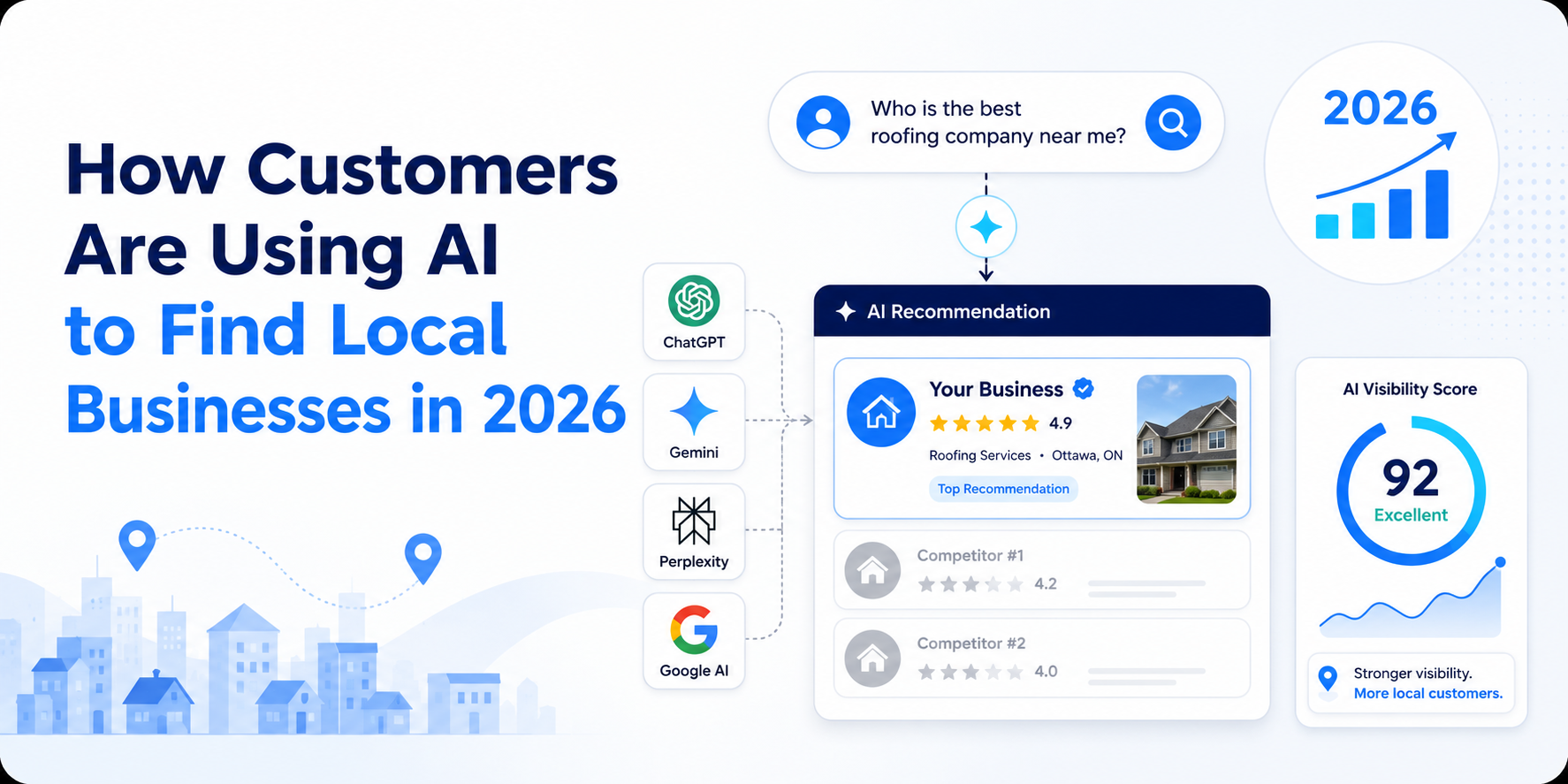
Customers are increasingly using AI tools such as ChatGPT, Gemini, Perplexity and Google AI to ask complete, conversational questions about local services.
Instead of typing a short phrase such as “roofing company Toronto,” a potential customer might ask:
- “Who is the best roofing company near me?”
- “Which local roofer has the strongest reviews?”
- “Who can repair my roof quickly after a storm?”
- “What roofing company serves my area and offers free estimates?”
The AI platform may then compare businesses, summarize their services and recommend a small number of options.
That creates a new challenge for local businesses: ranking on Google is still important, but businesses must also make it easy for AI platforms to understand who they are, what they do, where they operate and why customers should trust them.
If that information is missing, unclear or inconsistent, AI may recommend a competitor instead.
Local Search Is Becoming More Conversational
For years, local search was built around short keywords.
A homeowner who needed help might open Google and type:
- “Plumber near me”
- “Best HVAC company”
- “Roof repair Mississauga”
- “Fire protection company Toronto”
- “Electrician open now”
Those searches are not disappearing. Customers still use Google Search and Google Maps every day.
However, AI is changing how people begin the buying process.
Customers can now describe their full situation, preferences and concerns in one question. They can also ask follow-up questions without starting a completely new search.
ChatGPT Search, for example, can search the web, use general location information to improve relevant results and turn a conversational prompt into one or more targeted searches. Google AI Mode similarly allows people to ask longer, more nuanced questions and continue with follow-up questions.
A homeowner may now ask:
“Who is the best roofing company near me for an emergency leak, and which one has good reviews and financing?”
A business owner might ask:
“Which fire protection companies serve commercial properties in the Greater Toronto Area?”
Someone planning a renovation could ask:
“Compare three highly rated electricians near me that work on older homes.”
These are not simple keyword searches.
They are recommendation requests.
The customer is asking the AI platform to research, compare and narrow down the options before they contact a business.
AI Is Becoming Part of the Local Buying Journey
Traditional search often gave customers a page of links to review.
Conversational AI can provide a summarized answer.
That answer may include:
- Several recommended businesses
- A comparison of services
- Review or reputation information
- Locations and service areas
- Reasons one company may be a better fit
- Links to websites or business profiles
- Suggested next steps
Google has also introduced AI-powered local business capabilities that can help users research pricing and availability. These developments show how AI search is moving beyond answering questions and toward helping customers take action.
For local businesses, the goal is no longer only to appear somewhere on a results page.
The goal is to become one of the businesses that AI can confidently identify, understand and recommend.
That is where AI search visibility and answer engine optimization, commonly called AEO, become important.
What Is AI Search Visibility?
AI search visibility describes how accurately and consistently your business appears in answers generated by platforms such as:
- ChatGPT
- Google AI Overviews
- Google AI Mode
- Gemini
- Perplexity
- Other AI-powered search and recommendation tools
Strong AI visibility means these platforms can understand:
- What your business does
- Which services you provide
- Where you provide them
- Who you serve
- What makes your business different
- Whether your business appears trustworthy
- Whether the information about your company is consistent
Weak AI visibility means your business may be overlooked, inaccurately described or left out of the answer completely.
The difficulty is that many businesses do not know they have a visibility problem.
Their website may look professional. Their Google Business Profile may be active. They may even rank for a few important keywords.
But when someone asks ChatGPT or Google AI for a recommendation, the business may not appear.
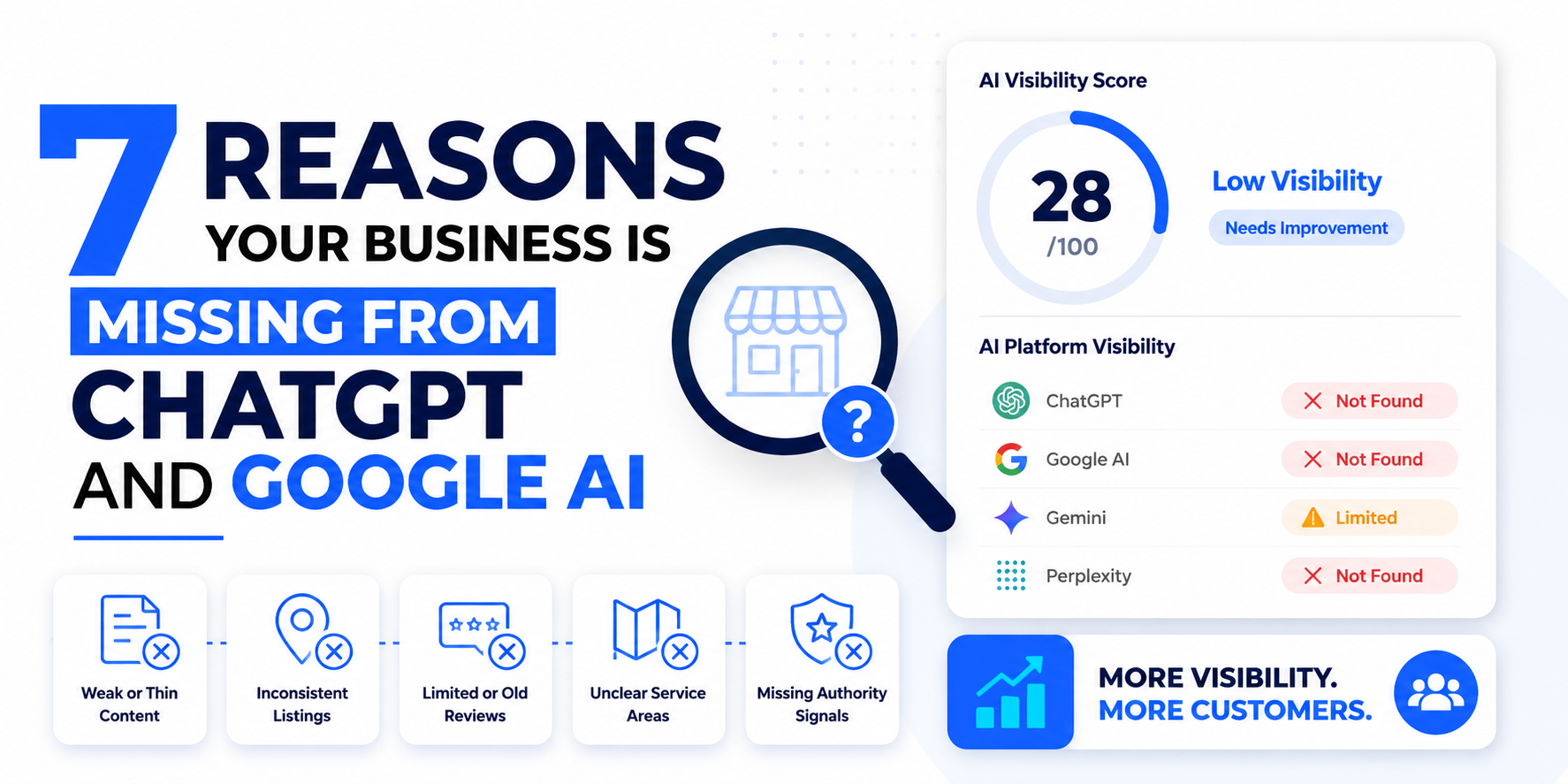
Five Common Reasons Local Businesses Are Missing From AI Results
1. Your Website Content Is Too Weak or Too General
AI platforms need clear information before they can understand and recommend your business.
A homepage that says “quality service you can trust” does not provide enough detail.
That same phrase could describe thousands of companies.
Your website should clearly explain:
- Your primary services
- The problems you solve
- The types of customers you serve
- The cities and communities you cover
- Your experience and qualifications
- How your process works
- Why customers choose you
- Frequently asked customer questions
For example, a roofing company should not rely on a single services page that briefly mentions “residential and commercial roofing.”
It may need dedicated, useful pages covering services such as:
- Roof repair
- Emergency roof repair
- Roof replacement
- Shingle roofing
- Flat roofing
- Commercial roofing
- Storm damage repair
- Roof inspections
These pages should answer the questions potential customers actually ask.
Google’s guidance for generative AI search continues to emphasize valuable, original, expert-led content along with clear technical structure and established SEO practices.
The more clearly your website explains your expertise, the easier it becomes for search engines and AI platforms to understand when your business is relevant.
2. Your Business Information Is Inconsistent
Your business name, address, phone number, website and service information may appear across dozens of online sources.
These can include:
- Google Business Profile
- Bing Places
- Apple Maps
- Industry directories
- Local business directories
- Chamber of commerce websites
- Review platforms
- Supplier or association websites
Problems occur when those sources do not agree.
One directory might list an old phone number. Another may use a previous business name. Your Google Business Profile might list a different website address than your Facebook page.
These inconsistencies can make it harder for search platforms to confidently connect the information to one business.
Complete and accurate business information is already important for traditional local visibility. Google specifically recommends maintaining detailed, current Business Profile information to help match businesses with relevant local searches.
In an AI-powered search environment, consistency becomes even more important because systems may review information from multiple sources before generating an answer.
3. You Have Too Few Reviews or Limited Reputation Signals
Reviews do more than influence customers after they discover your business.
They also provide information about what your company does and how customers experience your services.
A detailed review might mention:
- The service completed
- The city or neighbourhood
- The speed of the response
- The quality of the work
- The professionalism of the team
- The type of property
- The reason the customer recommends the business
Over time, these reviews help build a clearer picture of your company.
A roofing company with recent reviews discussing emergency repairs, storm damage and service in specific communities provides stronger context than a company with a handful of vague reviews from several years ago.
Google confirms that review quantity and positive ratings can contribute to local prominence, along with other signals such as links and general recognition across the web.
This does not mean businesses should chase reviews simply to satisfy an algorithm.
The goal should be to build a steady, authentic record of real customer experiences.
4. Your Service Areas Are Unclear
Many local service companies operate across several cities but barely mention those locations on their websites.
A contractor might write “serving the GTA” without identifying the specific communities it regularly serves.
That creates uncertainty.
When someone asks, “Who repairs commercial roofs in Oakville?” an AI platform needs evidence that the business actually serves Oakville and provides commercial roof repair.
Your service area should be supported by clear information across your:
- Website
- Google Business Profile
- Service pages
- Location pages
- Project examples
- Testimonials
- Frequently asked questions
- Directory profiles
Avoid creating dozens of thin pages that simply replace one city name with another.
Instead, build useful pages that explain the services you provide in each important market, common local customer needs and examples of relevant work.
The purpose is not to repeat a location as many times as possible.
The purpose is to remove uncertainty about where your business works.
5. Your Business Is Missing Authority Signals
AI platforms may be less likely to recommend a company when there is little evidence supporting its experience, reputation or legitimacy.
Authority signals can include:
- Professional certifications
- Industry memberships
- Licences
- Insurance information
- Awards
- Years of experience
- Case studies
- Completed-project examples
- Expert articles
- Local media coverage
- Supplier relationships
- Links from reputable websites
- Detailed team or company information
Imagine two plumbing companies offer the same service in the same city.
One has a basic website with a phone number and a short paragraph.
The other has detailed service pages, technician credentials, customer reviews, project examples, industry memberships and educational content answering common plumbing questions.
The second company gives search and AI systems more information to evaluate.
Authority is not created by adding a badge to the footer and calling yourself the best.
It is built by providing consistent evidence of your experience across your website and the wider web.
Does Traditional SEO Still Matter in 2026?
Yes.
AEO does not replace SEO.
Strong SEO helps ensure that your website can be crawled, indexed, understood and discovered. Those same foundations support visibility in AI-powered search.
Google’s official guidance states that established SEO best practices remain relevant for AI Overviews and AI Mode. It also recommends crawlable pages, strong internal linking, useful text-based content, accurate structured data and up-to-date Business Profile information.
The difference is that businesses should think beyond ranking for one exact keyword.
Your content must also help answer broader questions such as:
- Who is the best company for this service?
- Which provider serves my location?
- Which business is experienced with my type of problem?
- What should this service include?
- How do I compare local providers?
- What should I look for before hiring someone?
- Which company appears trustworthy?
SEO helps your information get discovered.
AEO helps make your business understandable and useful within an AI-generated answer.
Local businesses need both.
How to Improve Your AI Visibility
Improving AI visibility is not about finding one technical trick.
It requires strengthening the information and trust signals surrounding your business.
Start With These Seven Steps
1. Clearly define your services
Create useful pages for your most important services instead of listing everything in one short paragraph.
2. Explain your service areas
Identify the cities and communities you serve and support those claims with meaningful content.
3. Strengthen your Google Business Profile
Keep your categories, services, description, contact information, hours and photos complete and current.
4. Fix inconsistent business listings
Correct outdated or conflicting information across major directories and platforms.
5. Build a consistent review process
Ask real customers for honest feedback and respond professionally to the reviews you receive.
6. Publish expert-led content
Answer the questions customers ask before they call, book or request an estimate.
7. Add evidence of authority
Show qualifications, experience, project results, industry involvement and other trust signals clearly.
These steps help customers understand your business—and make it easier for search engines and AI platforms to do the same.
How to Find Your Biggest AI Visibility Gaps
One of the challenges with AI search is that businesses often do not know where they stand.
You may appear in one platform but be completely missing from another.
An AI platform may recognize your company name but misunderstand your services or service area.
You may also discover that competitors are being recommended for questions that should lead customers to your business.
A proper AI visibility review should examine:
- Whether your business appears in major AI platforms
- How accurately your services are described
- Whether your service areas are understood
- Which competitors appear more frequently
- How your reviews and reputation compare
- Whether your website provides enough useful information
- Which authority signals are missing
- What improvements should be prioritized first
Without this information, it is easy to spend time changing your website without addressing the gaps that matter most.
Find Out Whether AI Is Recommending You or Your Competitors
The way customers search for local businesses is changing.
Your next customer may not scroll through ten websites.
They may ask ChatGPT, Gemini, Perplexity or Google AI to recommend a business—and contact one of the companies included in the answer.
Kanuck AI’s Free AI Visibility Report helps Canadian businesses understand how they appear across AI-powered search platforms.
Your report can help identify:
- Where your business currently appears
- Which AI platforms recognize your company
- Whether your information is accurate
- Which competitors are being recommended
- The gaps limiting your visibility
- The highest-priority opportunities to improve
CTA button: Claim My Free AI Visibility Report
Takes less than 60 seconds. No credit card required.
Frequently Asked Questions About AI and Local Business Search
How are customers using AI to find local businesses?
Customers can ask AI platforms complete questions about the service they need, their location, timing, budget and preferences. The platform may then search for relevant information, compare businesses and present a summarized answer.
Is AI replacing Google Search?
AI is changing Google Search rather than simply replacing it. Google now includes AI Overviews and AI Mode, while customers also use separate tools such as ChatGPT and Perplexity. Traditional search, maps and AI-generated recommendations increasingly work together.
Does SEO help a business appear in ChatGPT and Google AI?
Strong SEO can improve the accessibility, clarity and authority of your website. These foundations can help AI-powered platforms find and understand your content, although no strategy can guarantee that a business will be included in a specific answer.
What is answer engine optimization?
Answer engine optimization, or AEO, is the process of making your business information easier for AI-powered platforms and answer engines to discover, understand and reference.
It usually involves clear website content, consistent business details, useful answers, structured information, reviews and credible authority signals.
Do I need separate websites for SEO and AEO?
No. Your primary website should support both.
Create useful content for customers, follow sound technical SEO practices and clearly explain your services, locations and expertise. Avoid building content solely for AI systems or relying on unproven shortcuts.
Why is my competitor appearing in AI answers instead of my business?
Your competitor may have clearer service content, stronger reviews, more consistent listings, better location information or more authority signals across the web.
An AI Visibility Report can help identify which of these gaps may be affecting your business.
Can AI visibility be guaranteed?
No legitimate provider can guarantee that an AI platform will recommend a specific business.
AI answers can change depending on the wording of the question, the customer’s location, available sources and platform updates.
The goal is to increase the clarity, consistency and authority of your business information so you have a stronger opportunity to be discovered.
Final Thoughts
Customers are not only searching for local businesses with short keywords anymore.
They are asking detailed questions and expecting AI to help them choose.
That means your business must be more than visible.
It must be understandable.
Your website, reviews, listings, service areas and authority signals should work together to give customers—and AI platforms—a clear reason to trust your company.
Businesses that make those improvements now will be better positioned as AI-powered discovery becomes a larger part of the local buying journey.
The first step is understanding how your business currently appears.
Claim your Free AI Visibility Report from Kanuck AI and discover whether AI is recommending your business—or your competitors.