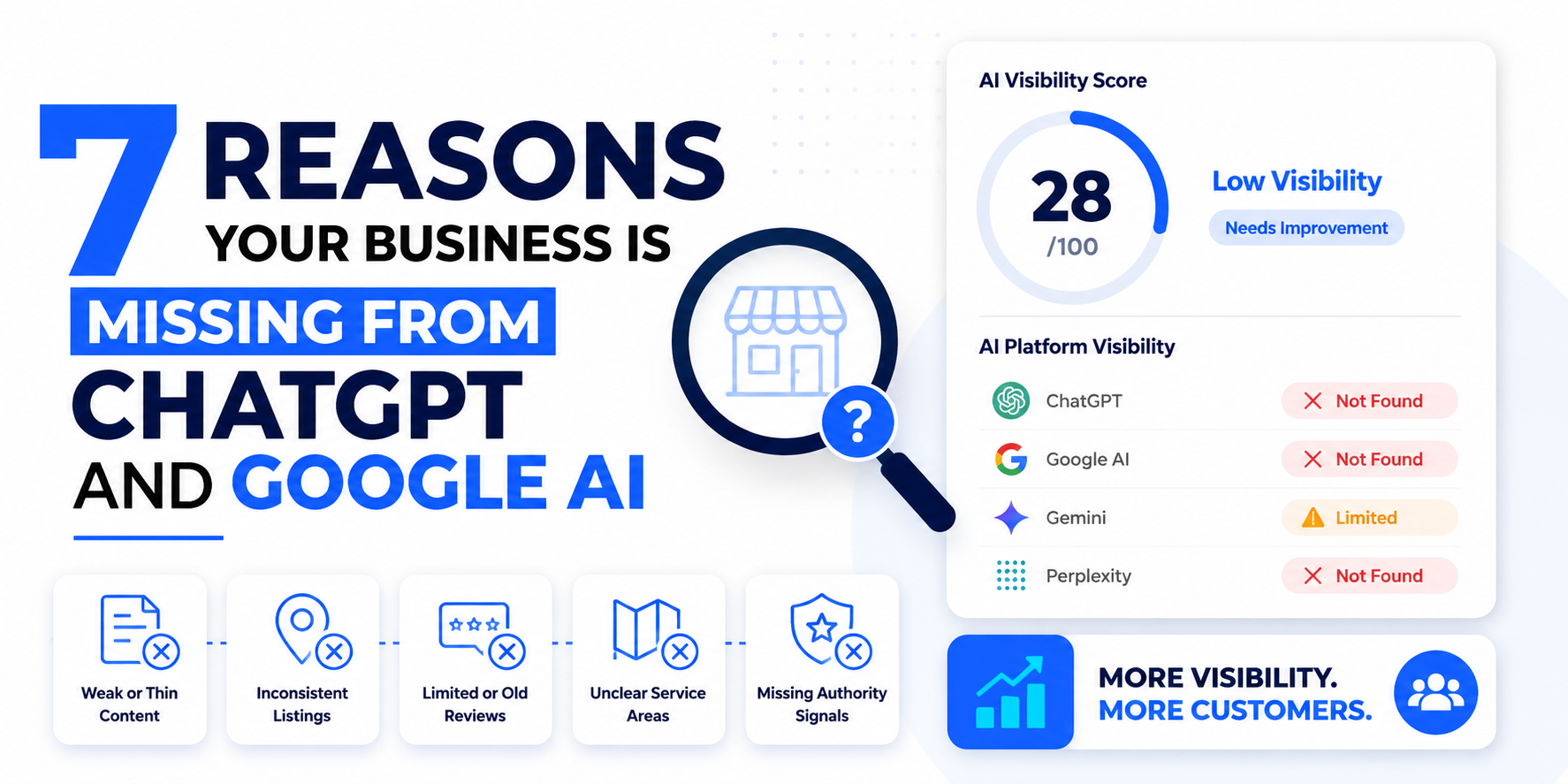
Is AI Recommending Your Business—or Your Competitors?

Darryl MacDonald
Excerpt: Learn what influences AI-powered recommendations and how to identify gaps in your business visibility.
When a potential customer asks ChatGPT, Gemini, Perplexity, or Google AI a question about your services, which businesses appear in the answer?
More importantly, does your business appear at all?
Customers are increasingly using AI-powered search tools to compare companies, research services, evaluate local providers, and decide who to contact. Instead of clicking through several websites, they can ask a direct question such as:
- “Who is the best plumber near me?”
- “Which roofing companies have strong reviews?”
- “What is the best local business for commercial fire protection?”
- “Who should I call for emergency HVAC service?”
- “Which company offers the best value in my area?”
The AI platform may then provide a summarized answer containing a small number of recommended businesses.
If your company is not included, the customer may never visit your website, see your offer, or contact your sales team.
The question is no longer simply whether your business ranks on Google.
The question is:
Does AI understand, trust, and recommend your business?
What Does It Mean for AI to Recommend a Business?
An AI recommendation happens when an AI-powered platform includes a business in its response to a customer’s question.
For example, someone may ask:
“What are the best home service companies in Toronto for a commercial property?”
The AI platform may respond with several companies, a summary of their services, review information, locations, advantages, and links to supporting sources.
Being mentioned in this type of answer gives a business valuable visibility at the exact moment a potential customer is considering their options.
However, AI recommendations are not random.
AI systems gather and interpret information from many online sources to determine which businesses appear relevant, credible, and useful to the person asking the question.
These sources may include:
- Your website
- Google Business Profile
- Online reviews
- Business directories
- Local listings
- Industry websites
- News articles
- Social media profiles
- Frequently asked questions
- Third-party mentions
- Customer discussions
- Structured website information
The clearer and more consistent your online presence is, the easier it may be for AI platforms to understand your business.
Why Your Competitors May Be Appearing Instead of You
A competitor does not necessarily need to be the largest or oldest company to earn more AI visibility.
They may simply have stronger digital signals.
For example, your competitor may have:
- More detailed service pages
- A better-optimized Google Business Profile
- More recent customer reviews
- More consistent business information
- Clearer location and service-area content
- More mentions on trusted websites
- Better answers to common customer questions
- Stronger industry authority
- More complete business listings
- Content that is easier for AI systems to understand
Your company may provide better service in the real world, but AI platforms can only evaluate the information available to them.
If your online presence is incomplete, inconsistent, vague, or outdated, AI may have difficulty determining when to recommend you.
That creates an opening for competitors.
The Main Factors That Influence AI-Powered Recommendations
No single factor guarantees that an AI platform will mention your business. Visibility is usually influenced by a combination of relevance, authority, trust, clarity, consistency, and local signals.
1. Clear Information About What You Do
AI systems need to understand your services before they can recommend your business.
A homepage that only says, “We provide quality solutions you can trust,” gives very little useful information.
Your website should clearly explain:
- What services you provide
- Who you help
- Where you operate
- What problems you solve
- What makes your company different
- How customers can contact you
Each major service should ideally have its own detailed page.
For example, a fire protection company may require separate pages for fire alarm inspections, sprinkler services, extinguisher maintenance, emergency lighting, monitoring, and commercial compliance support.
Specific content gives AI systems more context than broad marketing statements.
2. Strong Local Visibility
Local businesses need accurate location and service-area signals.
Your website, Google Business Profile, directory listings, and social profiles should consistently display your:
- Business name
- Address
- Phone number
- Website
- Service areas
- Business hours
- Service categories
Conflicting information can weaken confidence in your business.
If one website lists an old phone number, another shows an outdated address, and your Google Business Profile uses a different business name, both customers and AI systems may struggle to determine which information is correct.
3. Customer Reviews and Reputation
Reviews help demonstrate that your business is active, established, and trusted by real customers.
The number of reviews is important, but so are:
- Review quality
- Review recency
- Review frequency
- Customer language
- Your responses to reviews
- The platforms where reviews appear
Detailed reviews can also reinforce the services you provide.
A review that says, “Excellent service,” offers less context than one that says, “The team completed our annual fire alarm inspection, explained the deficiencies, and scheduled the repairs quickly.”
The second review helps customers and AI platforms understand what the company actually does.
4. Helpful, Expert Content
AI platforms are designed to provide useful answers.
Businesses that publish clear, accurate, and helpful content create more opportunities to be discovered and referenced.
Useful content may include:
- Service guides
- Cost explanations
- Comparison articles
- Frequently asked questions
- Maintenance checklists
- Buyer’s guides
- Local service information
- Industry updates
- Case studies
- Problem-and-solution articles
The goal is not to publish content simply for the sake of publishing.
The goal is to answer the questions your potential customers are already asking.
5. Authority and Third-Party Mentions
What your business says about itself matters, but what other websites say about your business can also influence visibility.
Third-party signals may include:
- Industry association listings
- Chamber of commerce profiles
- Local news coverage
- Supplier directories
- Partner websites
- Professional certifications
- Community sponsorships
- Customer case studies
- Business directory profiles
- Relevant backlinks
These mentions can provide additional confirmation that your business is legitimate and connected to its industry or community.
6. Consistency Across the Internet
AI systems may encounter your company on dozens of websites.
The information should tell a consistent story.
Your business name, services, location, expertise, and contact information should remain aligned across your website, listings, social profiles, and business directories.
Consistency builds clarity.
Clarity helps build trust.
7. Website Structure and Technical Accessibility
Your content must also be easy to find and understand.
A website may contain excellent information, but poor structure can make that information less accessible.
Important technical and structural elements include:
- Logical page organization
- Descriptive page titles
- Clear headings
- Internal links
- Fast-loading pages
- Mobile-friendly design
- Secure browsing
- Structured data
- Accessible contact information
- Search-engine indexing
Technical SEO and AI visibility are closely connected because both depend on making your website understandable and accessible.
How Can You Tell Whether AI Is Recommending Your Business?
You can begin by testing the questions your customers are likely to ask.
Search across platforms such as ChatGPT, Gemini, Perplexity, and Google AI using prompts like:
- “Who are the best [service] companies in [city]?”
- “Which local company should I hire for [specific problem]?”
- “Compare the top [industry] companies in [location].”
- “What businesses provide [service] near me?”
- “Who has the best reviews for [service] in [city]?”
- “What company would you recommend for [service]?”
Record which businesses appear, what information is included, and which sources are referenced.
Do not rely on one search.
AI responses can vary depending on the wording of the question, the platform being used, the customer’s location, and the available online information.
A proper AI visibility review should look for patterns across multiple questions and platforms.
Five Warning Signs That Your Business Has an AI Visibility Problem
Your company may have a visibility gap if:
1. Competitors appear repeatedly and your business does not
A single missing mention may not be meaningful. Repeated exclusion across several relevant searches deserves attention.
2. AI provides incorrect information about your business
Outdated services, locations, hours, or contact details can confuse potential customers and reduce trust.
3. Your business appears, but the description is vague
A generic description may indicate that AI platforms do not have enough detailed information about your company.
4. Your strongest services are not associated with your business
You may offer a valuable specialty, but your website and online profiles may not communicate it clearly enough.
5. AI cannot distinguish you from your competitors
If your online messaging sounds identical to every other business, there may be no clear reason for an AI platform to prioritize your company.
How to Improve Your AI Visibility
Improving AI visibility does not mean attempting to manipulate an algorithm.
It means making your business easier to understand, verify, and recommend.
Start with these priorities.
Clarify Your Core Services
Create a dedicated page for each important service. Explain the problem, your process, who the service is for, where it is available, and how customers can get started.
Strengthen Your Google Business Profile
Complete every relevant section, choose accurate categories, upload current photos, publish updates, answer questions, and keep your information accurate.
Build a Consistent Review Process
Ask satisfied customers for reviews while their experience is still fresh. Make the process simple and respond professionally to both positive and negative feedback.
Publish Answers to Customer Questions
Speak with your sales and customer-service teams. Identify the questions customers repeatedly ask before buying and turn those questions into useful website content.
Improve Local and Industry Listings
Find inaccurate, incomplete, or duplicate listings. Correct the information and build profiles on credible websites that matter to your industry and location.
Demonstrate Real Expertise
Publish case studies, explain your process, display certifications, introduce your team, and provide practical advice that reflects real experience.
Make Your Website Easy to Navigate
Customers and AI systems should be able to move easily from your homepage to your services, locations, proof, frequently asked questions, and contact information.
SEO and AEO: Why Your Business Needs Both
Search engine optimization, or SEO, helps your business improve its visibility in traditional search results.
Answer engine optimization, or AEO, helps your information become easier for AI-powered systems to understand and use when answering questions.
The two strategies overlap, but they are not identical.
SEO often focuses on helping a page rank for a search term.
AEO also focuses on whether your content directly answers a question, demonstrates expertise, contains supporting context, and can be confidently summarized.
A strong visibility strategy should include both.
Your business still needs:
- Search-friendly service pages
- Local optimization
- Technical SEO
- Relevant keywords
- Quality content
- Backlinks
- Reviews
It also needs:
- Direct answers
- Clear business information
- Well-structured content
- Frequently asked questions
- Strong entity signals
- Consistent third-party information
- Content written around customer intent
The objective is to help your business appear wherever customers are searching—whether that is Google, an AI assistant, a map result, a directory, or a traditional website.
Your Competitors Are Already Creating AI Signals
Every new review, service page, directory listing, customer question, local mention, and helpful article provides more information about a business.
That information can strengthen the company’s digital presence over time.
Waiting carries a cost.
While you delay reviewing your AI visibility, competitors may continue improving the signals that influence how they are discovered.
The good news is that many visibility problems can be identified and corrected.
The first step is understanding your current position.
Find Out Whether AI Is Recommending Your Business
Kanuck AI’s Free AI Visibility Report shows how your business appears across major AI-powered platforms and where potential visibility gaps may exist.
Your report can help you identify:
- Whether AI platforms mention your business
- Which competitors appear more frequently
- How your business is described
- Which services are associated with your company
- Potential website and content gaps
- Local visibility and reputation signals
- Priority opportunities for improvement
You should not have to guess whether AI understands your business.
Claim your Free AI Visibility Report and see whether AI is recommending your company—or sending potential customers to your competitors.
CTA button: Get My Free AI Visibility Report
Frequently Asked Questions
What is AI visibility?
AI visibility describes how often and how accurately a business appears in answers generated by platforms such as ChatGPT, Gemini, Perplexity, and Google AI. It includes whether the business is mentioned, how it is described, and which services or locations are associated with it.
How do AI platforms choose which businesses to recommend?
AI platforms may use information from websites, business profiles, reviews, directories, trusted publications, local sources, and other publicly available content. Recommendations can be influenced by relevance, authority, reputation, consistency, location, and the wording of the customer’s question.
Can a local business improve its AI visibility?
Yes. A local business can improve its visibility by publishing clear service information, strengthening its Google Business Profile, earning customer reviews, correcting directory listings, creating useful content, and building credible third-party mentions.
Is AI visibility the same as SEO?
No. SEO focuses primarily on visibility in traditional search-engine results. AI visibility also considers whether AI systems can understand, summarize, and recommend a business when answering a customer’s question. The strongest strategy combines SEO and AEO.
How do I check my business’s AI visibility?
You can manually test relevant customer questions across several AI platforms. For a more complete assessment, an AI visibility report can compare platforms, competitors, business descriptions, reputation signals, and potential content gaps.
Why is my competitor appearing in AI answers instead of my business?
Your competitor may have clearer service pages, stronger reviews, more accurate listings, better local optimization, more helpful content, or more third-party mentions. An AI visibility review can help identify the specific gaps affecting your business.
Take the First Step
Your customers are already using AI to research companies, compare providers, and make buying decisions.
The businesses that are easiest to understand and trust have a better opportunity to be included in those conversations.
Find out where your company stands.
Get your Free AI Visibility Report from Kanuck AI today.